
Keywords
adenoma
screening
colonoscopy
fecal occult blood test
quality indicators
data
statistical analysis
Abstract
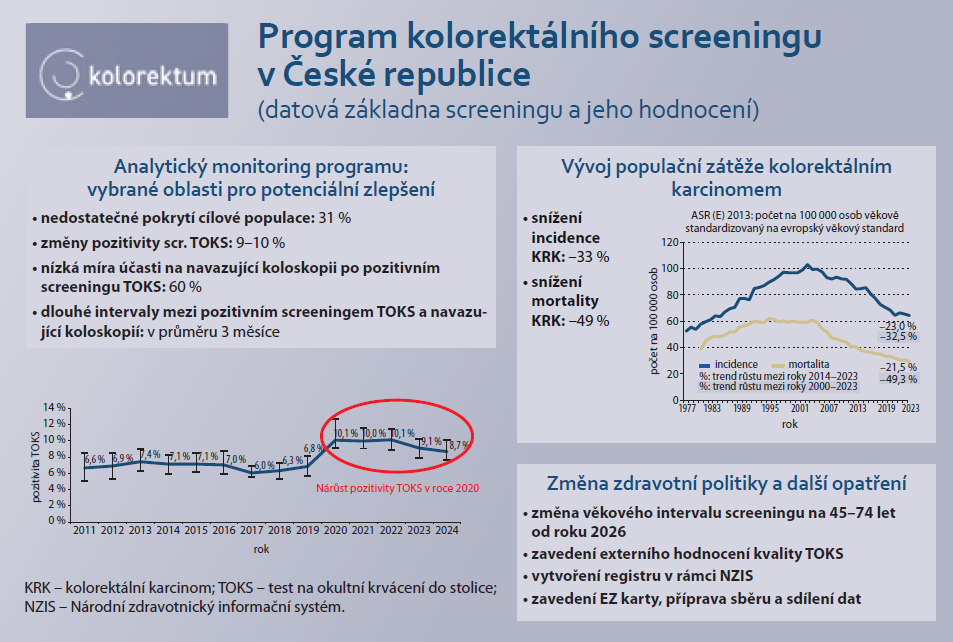
Introduction: Colorectal cancer (CRC) screening is a key tool for secondary prevention, whose effectiveness depends on population participation, accessibility of care, and quality of the examinations. Its impact is further determined by systematic data collection and analysis. High-quality data represent a fundamental pillar for monitoring ongoing screening, evaluating outcomes, and identifying weaknesses in the program. The aim is to demonstrate the benefits of data for optimizing the Czech program through two case studies. Methods: Data sources included the National Health Information System and the Database of Preventive Colonoscopies managed by the Institute of Health Information and Statistics of the Czech Republic, complemented with sociodemographic data from the Czech Statistical Office. Evaluation was carried out using screening quality indicators and a budget impact analysis focused on the change of age limits in screening. Results: The first case study shows a 33% decrease in CRC incidence and a 49% reduction in mortality since program implementation. Coverage of the target population has long remained around 30%. In 2020, a positive fecal occult blood test (FOBT) rose to 10%. The interval between a positive FOBT and follow-up colonoscopy corresponds to 3 months. The uptake of follow-up colonoscopy after a positive FOBT reaches 60%. The second case study revealed that expanding the eligible age range from 45–74 years will initially lead to a 5–6% increase in costs; however, from 2029 onwards, a reduction is expected. Discussion: The first study demonstrates the success of screening in reducing incidence and mortality, while also highlighting challenges such as low coverage, high FOBT positives, long waiting times for follow-up colonoscopy, and low uptake of follow-up colonoscopy. The second study found that expanding the age range will be cost-effective. Data confirm the benefits of screening for population health and indicate areas requiring further attention. Conclusion: Systematically collected and analyzed data are an essential component for evaluating and managing screening programs. The case studies illustrate their applicability in monitoring care quality and supporting health policy decisions.