
Keywords
pancreatic neoplasms
biopsy
fine-needle
retrospective studies
survival analysis
adenocarcinoma
multidisciplinary communication
Abstract
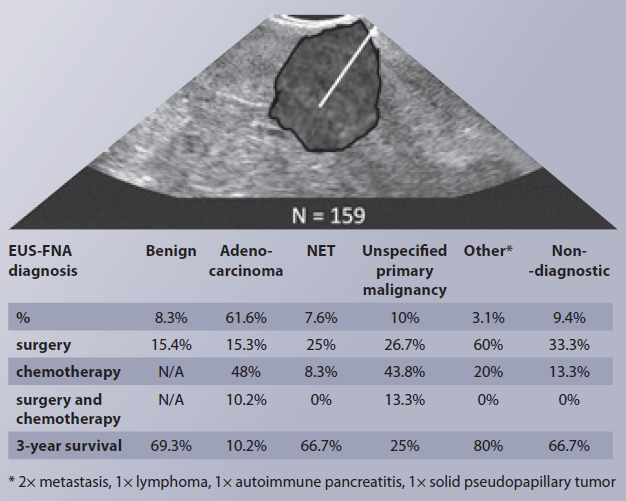
Background: Solid pancreatic lesions (SPLs) pose significant diagnostic and therapeutic challenges due to their high malignant potential and limited treatment options. Endoscopic ultrasound (EUS) -guided tissue sampling has become a cornerstone in their evaluation, offering minimally invasive access for histological confirmation. This study aimed to assess the clinical utility of EUS-guided biopsy for SPLs in a single center. Methods: We retrospectively analyzed patients who underwent EUS-guided tissue sampling for SPLs at the University Hospital Bratislava between 2018 and 2023. Exclusion criteria included cystic lesions or negative EUS findings. Data on demographics, lesion characteristics, sampling techniques, pathology, treatment modalities, and survival outcomes were collected. Diagnostic categories were stratified, and survival analyses were performed using Kaplan-Meier curves and Cox regression modeling. Results: Out of 747 EUS procedures, 159 met the inclusion criteria. The median patient age was 67 years; 62.3% were male. The most frequent diag- nosis was pancreatic adenocarcinoma (61.6%), followed by unspecified malignant lesions (10.1%), benign lesions (8.2%), and neuroendocrine tumors (7.5%). Malignant or potentially malignant lesions accounted for 83.9% of cases. EUS-guided biopsy was diagnostic in 90.6% of cases with no major complications recorded. Treatment (surgery, chemotherapy, or both) was administered to 48.4% of the patients. Surgical intervention and chemotherapy were both associated with significantly improved survival, with the best outcomes observed in patients receiving combined therapy. Surgery was the only independent predictor of reduced mortality (HR = 0.376; P = 0.002). Conclusion: EUS-guided sampling is a safe and effective tool for diagnosing SPLs, with high diagnostic yield and direct impact on treatment planning. Integration of histological findings into multidisciplinary management significantly influences prognosis, particularly in patients eligible for surgical resection and/or chemotherapy. These findings underscore the pivotal role of EUS within a coordinated care framework for SPLs.