
Keywords
manometry
home biofeedback
stimulation
cough
Abstract
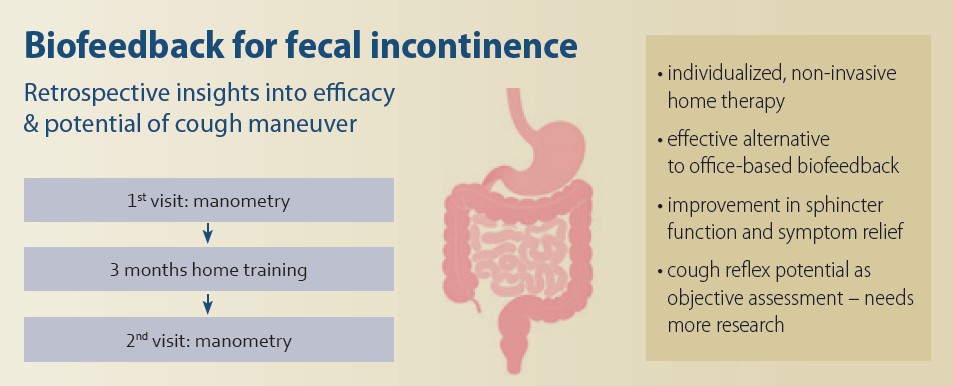
Background: Fecal incontinence is defined as the recurrent uncontrolled passage of feces. It is a relatively common disorder with a prevalence of up to 7% of the population worldwide. The therapy for fecal incontinence should be individualized, such as biofeedback training. However, there is no universal consensus on the method of evaluating its efficacy. Aim and methods: To evaluate the utility of the cough maneuver for assessing the efficacy of anal sphincter training. This is a retrospective analysis of a cohort of patients with fecal incontinence who underwent home biofeedback training with local electric stimulation for 3 months. Results: During the analyzed period, 50 patients were randomly assigned to one of two types of devices based on current availability. Data from 29 patients have been evaluated for the final analysis. Statistically significant improvements were found in rest maximum pressure, voluntary maximum pressure, and Wexner score when comparing the pre- and post-intervention. However, differences in rest mean pressure and pressure during cough were not significant, although there was a tendency toward post-intervention improvement. Conclusion: The data presented here provide evidence that home-based biofeedback training with local stimulation presents an effective alternative to office-based biofeedback training in patients with fecal incontinence. Besides the standard manometry parameters utilized for anorectal function assessment, the pressure during voluntary cough could provide a clinical utility even in patients without spine or peripheral nerve lesions, but further studies are needed to evaluate this hypothesis.